We Ran Ten Years of Kicker and Defense Data and the Top of Both Positions Is Still Underpriced

The truth
The top kicker and the top defense finish every season worth about as much as ordinary starters elsewhere in your lineup when you measure everyone by points above the average starter at his own position. The difference is the price.
Those other starters require real draft capital. A kicker or defense usually costs you a pick near the end of that draft in a spot that only produces a useful skill-position starter about two percent of the time. That is the whole argument. Similar value, at a fraction of the cost.
The reason most managers do not act on it is not the evidence. It is the belief that the late-round pick they are saving might become a sleeper. Ten seasons of results say that outcome is much rarer than people think.
How we tested it
We pulled every regular-season kicking and defensive stat line from 2015 through 2024. Kicker scoring was built from field goals made and missed by distance, plus PATs. Team defense scoring included sacks, takeaways, defensive touchdowns, and tiered points allowed.
Skill positions came from full-PPR season totals. We used standard 12-team starter counts and measured every player against the average starter at his own position, the same baseline we use throughout our work.
These are real season totals from the same players, same games, and one consistent scoring system. No projections and no simulated leagues. The full method and per-season tables are included in the accompanying data run.
The yardstick, points above the average starter
We use one number throughout this analysis. Take a player’s season total and subtract the average of the starters at his own position. That is his value over average, measured in points. Nothing is normalized. Nothing is rescaled. There is no replacement-level or last-startable baseline.
Points are also the right currency for the draft decision because points are what your fantasy lineup adds together. If one starter gives you 25 points above the average player at his position and another gives you 20, the first player added more to your season, even if that player was a kicker or defense.
Finding one, the top kicker and defense are priced near-zero and produce like starters
Here are the median points above the average starter at each position by finishing rank across the 2015 through 2024 seasons.
| Rank | QB | RB | WR | TE | K | DEF |
|---|---|---|---|---|---|---|
| 1 | +84 | +153 | +124 | +76 | +25 | +34 |
| 2 | +35 | +109 | +80 | +54 | +17 | +23 |
| 3 | +32 | +90 | +72 | +35 | +10 | +12 |
| 4 | +20 | +70 | +47 | +30 | +5 | +9 |
| 5 | +2 | +48 | +34 | +11 | +1 | +3 |
| 6 | -10 | +40 | +30 | +1 | -1 | -2 |
The top kicker finished a median 25 points above the average starting kicker. The top defense finished 34 points above the average starting defense. Both were positive in all ten seasons. There is no cherry-picked window and no single year carrying the result.
Now put those numbers on the same board as everyone else.
The top defense at +34 lands with the fifth-best receiver in the league, ahead of the third-best quarterback and roughly even with the third-best tight end.
The top kicker at +25 lands ahead of every quarterback outside the top four, ahead of the fifth-best tight end, and roughly even with the seventh-best running back or receiver.
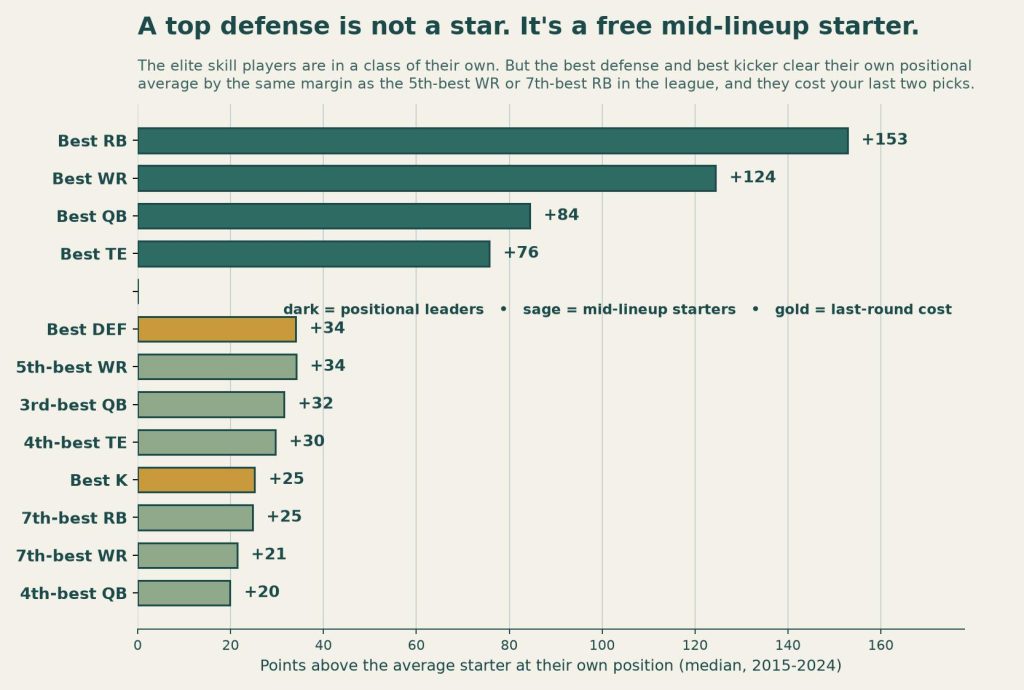
Rank all 96 startable finishers by points above the average starter at their own position and the median board position over these ten seasons is 21st for the top kicker and 18th for the top defense.
That is the part worth paying attention to. Those are not elite-player results. The top running backs and receivers are still in another class entirely. But these are legitimate starter-sized advantages, similar to players people routinely spend meaningful draft capital on – similar to players who are picked in the top four rounds of drafts.
The difference is what you paid. A top-five receiver or a top-three quarterback costs a real pick. A top-four kicker or defense usually costs a pick whose alternative is a bench player you may cut by October. Similar value. Completely different price.
We’re not saying get your kicker and defense in round four, but I sure wouldn’t wait until the end. Your job is to compile as many points over your opponents as you can. So get the top defense and kicker, even if it means doing it much earlier than you’re used to.
Finding two, the late-round sleeper is a story more often than a strategy
Now look at the pick you are actually giving up in rounds 12 through 14. It’s not a starter. It is a bench skill-position player.
We measured how often those late skill picks turned into what managers hoped they would become, a player who finished the season above the average starter at his position.
Across these ten seasons, the rate was about two percent. The pick you are protecting by waiting on kicker becomes an above-average starter about one time in fifty.
Now compare the two options.
A top-four kicker or defense is a starting asset capable of creating a real weekly edge. The alternative is a two-percent shot at a contributor and, most of the time, a bench player you eventually cut.
There is also a simple games-played difference. Your kicker scores for you every week you own him. Your fifth running back only matters when something changes ahead of him.
Finding three, chase the band instead of the exact name
The edge declines as you move down the rankings, but it does not disappear immediately.
Ranks one through four still hold real value at both kicker and defense. After that, the advantage gets much thinner.
You are not trying to land the single best kicker. You are trying to land one of the top four.
That is a much more realistic target.
Defense is the one position where being right on the exact team can occasionally produce a major bonus. Jacksonville in 2017, Chicago in 2018, New England in 2019, and Denver in 2024 all finished 21 to 44 points ahead of the second-best defense.
Kicker was different. In four of the ten seasons, the gap between K1 and K2 was two points or fewer. Brandon Aubrey in 2023 was the exception.
So defense gives you more reason to be first to a specific unit. I’d even take two top ones.
At kicker, buy the tier and refuse to pay for the name.
The objections
“But the drop from RB13 to RB14 could be 50 points, so a below-average running back beats a positive kicker.”
The logic sounds reasonable. The data does not support it.
The median drop from one startable running back to the next in the RB13 through RB24 range was under 3 points. That part of the board is usually crowded, not full of massive cliffs.
The largest gap anywhere among below-average startable finishers over these ten seasons was about 33 points, and it happened at quarterback.
A 50-point gap between consecutive running backs in that range did not happen once.
“They are all the same. I will get one of the twelve anyway.”
There is plenty of supply, and that is exactly why this is a top-four argument rather than an argument for spending a premium pick on the position.
Roughly 32 kickers play meaningful seasons for twelve starting kicker spots in a fantasy league. Waiting will not leave you without a kicker, but it will leave you without an advantage at the kicker position. If you take an average kicker, you’re only at a disadvantage a couple times a year when you play the team with the top couple kickers. If you get the top couple kickers though, you’ve got an advantage nearly every week of the season.
“You cannot know who the top one will be.”
Correct. But that’s the entire nature of fantasy football at every position.
We tested the signal available in this data. A kicker who finished top three the previous season averaged 11 points below average the following year, and only 35 percent finished above average.
Previous top-three defenses averaged 15 points below average the following season.
Last year’s finish is not a reliable way to identify this year’s elite kicker or defense. We are not pretending otherwise.
Both parts of the argument have to stay together. The value at the top is real. Identifying the exact player before the season is difficult.
That is why this is a top-four band argument, not a claim that you can perfectly predict K1 or DEF1.
The other side of the decision still matters. The late-round skill player you are passing on, that you also have to guess correctly, becomes an above-average starter about two percent of the time.
“Kickers are a crapshoot.”
So is every position.
Top-three finishers repeating a top-three finish the next season came in at 26.9 percent for kickers, 25.9 percent for receivers, 22.2 percent for defenses, and 19.2 percent for running backs.
Kickers actually repeated at the highest rate of the four.
“You have to guess” describes fantasy football. It is not unique to kicker.
“Your yardstick ignores positional scarcity, so of course kickers look fine.”
We tested that directly in two different ways.
First, we applied the same tier-cliff adjustment our tools use for scarce positions and extended it to kicker and defense. It moves every position by roughly the same amount, so very little changes. The top kicker moves from about 21st among all starters to 20th. The top defense moves from 18th to 17th.
Then we used a harsher version and charged each position for the points you lose by waiting one turn in the draft. That pushes kicker and defense down, but not very far. The top kicker moves to roughly 26th and the top defense to roughly 23rd. They still land nowhere near the 40th-best starter range that conventional draft advice would imply. So we gave kicker and defense the scarcity credit, then charged them the scarcity penalty.
Both approaches left the top finisher at each position somewhere inside roughly the top 25 startable players in football.
What to actually do
Fill your starting lineup first. Nothing here argues for taking a kicker over someone you expect to start. This argument begins in the back half of the draft.
Buy the value while it is cheap. Once you are choosing between bench players, you are comparing a real starter-sized edge with a skill-position pick that becomes an above-average starter about two percent of the time. And, in reality, you’ve got more sleepers on your cheat sheet than you can draft, so there will be plenty left to pick from in round 15 and 16.
Take the kicker and defense you want a round or two before the rest of the room. In most drafts, that means rounds 12 through 14 instead of the final two picks.
You are not paying up for them. You are paying almost nothing for players you intend to start while everyone else is paying almost nothing for lottery tickets.
Aim at the band, not the exact name. Any of your top four options at either position gives you access to the part of the curve where the edge still exists.
Spend the extra pick on defense. Top defenses sometimes separate from the rest of the position by 20 to 44 points, so being first to the unit you want can matter. At kicker, the next option was often only a couple of points behind.
Have a reason for the pick. A defense with a strong pass rush and a soft opening schedule. A kicker attached to a good offense, playing in a dome or warm climate, with a coach willing to kick from distance.
Those are reasons, not proven predictors, and they should be treated that way.
Kickers
| Band | Kicker | Team | Our proj. pts | Our ADP | Public consensus | Reasoning |
|---|---|---|---|---|---|---|
| Buy band | Brandon Aubrey | DAL | 145 | 137 | K1 nearly everywhere | Longest usable range in the league and a coaching staff that lets him try from distance. Our projection and consensus agree, and the new contract signals the team is committed to using him. |
| Buy band | Cameron Dicker | LAC | 125 | 150 | K1 to K3 (SI has him first) | Accuracy plus a competent offense. He is the one name where a major outlet ranks him above Aubrey, so if Aubrey is gone this is not a downgrade you need to feel bad about. |
| Buy band | Ka’imi Fairbairn | HOU | 104 | 164 | K2 to K3 | Houston stalls in field-goal range often, which is a kicker’s best friend. Cheapest of the top three in our ADP. |
| Buy band | Cam Little | JAC | 91 | 173 | K5 | Big leg, improving offense. Our projection likes him more than consensus does, and he is the best value of the four if you are drafting near the back of the band. |
| Next up | Tyler Loop | BAL | 82 | 179 | K7 | Inherits one of the best scoring offenses. Fine fallback. |
| Next up | Jason Myers | SEA | 70 | 187 | K4 | Consensus likes him more than our points projection does. See the conflict note below. |
| Next up | Eddy Pineiro | SF | 65 | 190 | K6 | Volume from a strong offense; both views treat him as a back-of-band option. |
| Flat part | Jake Bates | DET | 61 | 193 | K8 to K10, higher at SI/Yahoo | Real leg strength, but Detroit finishes drives in the end zone. |
| Flat part | Harrison Mevis | LAR | 50 | 200 | K11 | Situation is good, the projection is not. |
| Flat part | Cairo Santos, Harrison Butker, Evan McPherson, Andres Borregales | 40 to 44 | 204+ | K9 to K12 | This is the flat part of the curve the article warns about. If you are here, take the cheapest one and move on. |
Take: Aubrey, Dicker, Fairbairn, Little. That is the band. Ordering inside it barely matters, so let ADP decide.
Defenses
| Band | Defense | Our proj. pts | Our ADP | Public consensus | Reasoning |
|---|---|---|---|---|---|
| Buy band | Houston Texans | 72 | 156 | DST1 in most places | Pass rush that generates sacks and turnovers on its own, without needing the offense to cooperate. Our projection and consensus both put Houston first. |
| Buy band | Denver Broncos | 71 | 167 | DST2 | Pressure plus a secondary that takes the ball away. Agreement across both views. |
| Buy band | Los Angeles Rams | 68 | 174 | DST4 | Front seven continuity. Priced a full round behind Houston in our ADP for a very similar projection. |
| Buy band | Minnesota Vikings | 67 | 229 | DST7 | The largest value gap on this page. Our projection has Minnesota fourth; the market drafts them nineteenth among defenses. Aggressive blitz scheme means high variance, which is exactly the profile you can afford at that price. |
| Next up | Seattle Seahawks | 65 | 169 | DST1 to DST3, SI has them co-first | Strong unit, but our projection is fifth, not first. See conflict note. |
| Next up | Pittsburgh Steelers | 66 | 189 | DST9 | Sack volume. Our projection likes them more than the market does. |
| Next up | Detroit Lions | 65 | 217 | outside most top twelve | Another spot where our projection is ahead of the market. |
| Next up | Baltimore Ravens | 63 | 203 | DST11 | Talent up front, script-dependent. |
| Flat part | Philadelphia, LA Chargers, Jacksonville, Kansas City, Green Bay | 59 to 62 | 176 to 224 | DST5 to DST12 | Real defenses, flat fantasy separation. Cheapest available is the right answer. |
Take: Houston, Denver, or the Rams if the price is right, and Minnesota as the value play if you would rather spend the earlier pick elsewhere.
Where our projections and public consensus disagree
Three conflicts are worth stating out loud rather than papering over.
Jason Myers. Consensus has him around K4. Our projection has him seventh among kickers by points. Both can be true: Seattle plays a ball-control style that produces attempts, and our model is more skeptical of the conversion volume. We are not putting him in the buy band, but we are not calling him a mistake either.
Seattle’s defense. SI treats Seattle as co-best in football, and our projection has them fifth. The gap is a modeling difference about how much last season’s points-allowed rate carries forward. At their ADP of 169 you are paying near-top-three prices for our fifth-ranked unit, so we prefer Houston, Denver, or the Rams at similar or lower cost.
Minnesota’s defense. Consensus is around DST7, our projection is fourth, and the market drafts them at pick 229. When our projection and the price disagree that badly, the pick is cheap enough that being wrong costs nothing. This is the single best expression of the article’s argument on the 2026 board.
Jake Bates. SI and Yahoo rate him near the top tier; our projection and the consensus both have him around K8 to K10. We are siding with the projection.