The 2026 Draft Board You Should Actually Use (And Why It’s Not ADP)

Every draft board you have used answers the wrong question
ADP tells you when a player is being picked. Expert rankings tell you who someone else likes. Tiered boards tell you where the cliffs are. None of them answer the only question that matters on the clock: how much is this player worth compared to the guy you will get in his place if you wait a round?
That question has an answer. It is called value over the average starter, and once you draft with it, ADP stops looking like a board and starts looking like a crowd.
What ADP actually is
ADP is a popularity contest. It is the average pick number across thousands of drafts, most of them mocks run by people who are also just looking at ADP. It is a feedback loop.
Two things follow from that:
- ADP is a lagging indicator. By the time a player’s ADP has moved up, the edge is priced in. You are buying at the top.
- ADP compresses value. A player going 14th and a player going 22nd look eight picks apart. In reality one might be worth 40 more fantasy points across the season and the next one might be worth two.
Your board needs to tell you how much better one player is than the next-best option at his position, not when he goes.
Value over the average starter, explained
The metric is simple:
Value = Player projected points - (average points of starting-caliber players at that position)
Use the average starter, not replacement level. Classic value-based drafting measures against the worst starter or the first man off waivers. That is a leftover from a different era, and it inflates positions where the bottom is truly dire (tight end, mostly). You are not going to play against the worst tight end in the league all year. On average, you are going to someone in the middle of the pack. Measure against that.
The three things this fixes about your draft
1. It kills the reach
You know this spot. Fourth round. Your board has a wide receiver ranked 32nd overall who “should be there next round,” so you take a running back instead.
Except that receiver is worth 38 points above his positional starter average, and the back you took is worth 11. You just left 27 points on the table because you told yourself the receiver would be around.
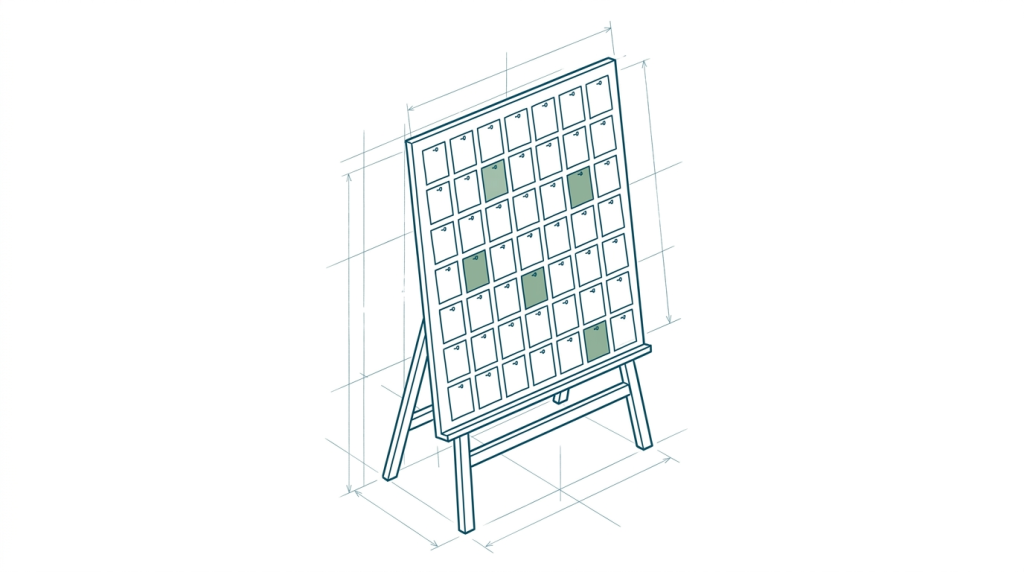
The matrix cheat sheet gives you players ordered by their actual value over the average starter, so you’ll see their true value and know you should take that wide receiver instead. The matrix cheat sheet already builds positional scarcity in, so if you see a running back ranked higher on a cheat sheet than a wide receiver who might have a higher raw value over average, that’s building in the concept that a comparable running back might not be available later, but a comparable wide receiver might me.
2. It respects your league’s scoring
Half PPR, full PPR, superflex, tight-end premium: every one of those tweaks moves player values in different directions, and ADP takes weeks to catch up.
Compute value on your own league’s scoring settings and the board you get is your league’s board, not the internet’s. In a superflex league, the top quarterback is not going 15th overall anywhere online, but on your board he is a 90-point edge and every other position has to earn its way past him.
3. It exposes the flex trap
Here is the one most drafters miss. If your league starts a WR/RB/TE flex, that slot is almost always a receiver. Not because receivers are more valuable in the abstract, but because more receivers project above the flex threshold than backs or tight ends. Your average flex starter is a receiver. That also speaks to the scarcity of true starting-caliber running backs – draft them early and often.
That means receivers should be measured against the receiver-plus-flex pool. Do that, and receivers earn higher values than a raw points ranking suggests, which is why “reach for the running back” advice from 2015 keeps losing leagues in 2026. If you do get three starting-caliber running backs, you can reassess each week during the season, but don’t get a flex running back just to have one if there are more valuable wide receivers available.
The invariance rule
This is the part that trips up smart drafters, so read it twice.
Value does not change as players come off the board.
If the top back goes first overall, the running back starter average does not shift. If eight receivers go in the first two rounds, the receiver starter average does not shift. The baseline is fixed for the entire draft.
Why? Because the average starter is a projection of who finishes as a starter, not who is currently available. A receiver being drafted at pick 6 does not make the WR12 any less of a WR12. He is still going to score what he is going to score.
Live tools that shift values every pick are selling you noise. Real value is set the moment projections are set. Everything after that is draft order.
The practical upside is enormous: you can pre-plan your board and trust it. No frantic recomputation every 90 seconds.
What you are going to notice
You will take players “too early” by ADP. You will pass on players your leaguemate loves. You will finish with a roster that looks a round too aggressive at three spots and a round too patient at two.
That is the point. ADP is what the room is doing. Value is what wins.
The teams that beat you last year were not better at reading the room. They were reading a different board. You’re Blueprint people – you’ve got the best cheat sheet in the business.

Responses