The Quarterback Break-Even: How to Think About Paying Up vs. Streaming

The wrong question
Most quarterback debates start with the wrong question.
“Is quarterback worth drafting early?”
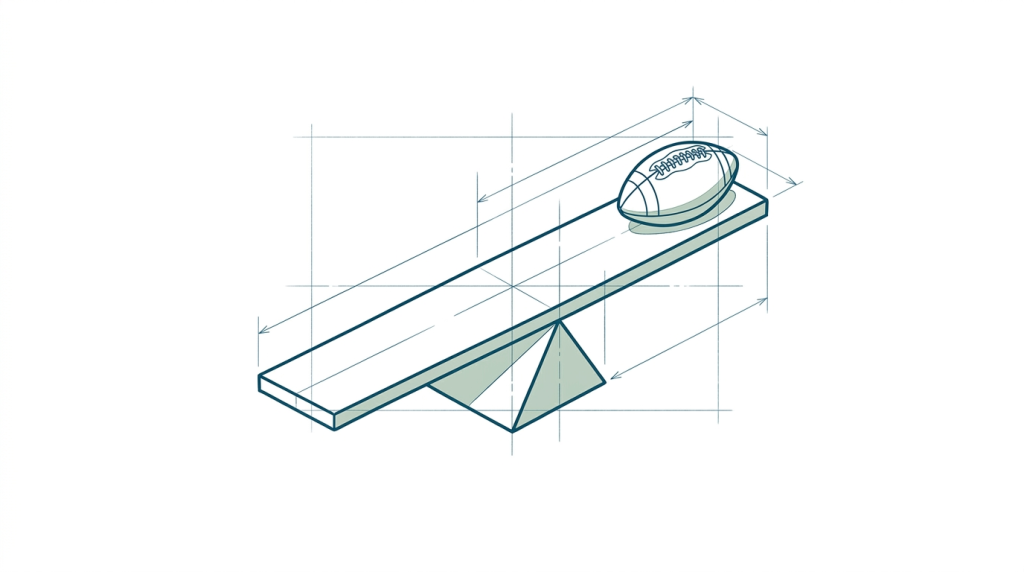
The problem is that there isn’t one answer that works in every draft. A better way to look at it is as a break-even calculation. How much value over the average starter am I giving up at running back or receiver by spending a pick on a quarterback here, versus how much value am I gaining at quarterback by not waiting?
Thinking about it this way gives you something more useful than a blanket rule about drafting quarterbacks early or late. You can actually compare the players available each time you’re on the clock.
Why quarterback value looks different from running back and receiver value
Quarterbacks score more total fantasy points than any other position, but they also cluster tighter. To compare positions fairly, we need to use the same definition of baseline everywhere. We use the average projected points of the entire starter pool at each position. In a 12-team single-quarterback league that means the average of the top 12 quarterbacks.
Measured that way, the gap between the best quarterback and an average starting quarterback is usually much smaller than the equivalent gap at running back or receiver. Passing production is more evenly distributed across starting quarterbacks than rushing or receiving production is across starting backs and receivers.
The important part is the distance between “elite” and “replaceable.” That gap is narrower at quarterback in most season-long single-quarterback formats. That smaller gap is what makes streaming – rotating matchup-favorable quarterbacks off the waiver wire week to week – a viable plan in a way that streaming running back or receiver almost never is.
The break-even math
Ask two questions before you draft a quarterback earlier than the room expects.
- What’s the value gap between the quarterback in front of me and the quarterback I could get three or four rounds later?
- What’s the value gap between the running back or receiver in front of me and the next player at that position?
If the quarterback gap is bigger than the skill-position gap, pay up. If the skill-position gap is bigger, wait. The answer can change from draft to draft depending on the depth of that year’s quarterback class and the depth of that year’s running back and receiver classes.
Some years the top four or five quarterbacks separate meaningfully from the pack because a handful of passers are also dangerous runners, adding a scoring floor that pure pocket passers can’t match. When that happens, there’s more reason to attack quarterback early because waiting costs you considerably more projected value. Other years the top twelve quarterbacks are packed closely enough together that waiting costs very little.
What this year’s class actually looks like
Using our half-point projections and current ADP, 2026 looks like a one-name year at quarterback. We’re scoring each player by how far he sits above or below the average starter at his position. The quarterback baseline is 307 points, the average of the top 12 projected quarterbacks.
| Rank | Player | ADP | Projected points | Value over average starter |
|---|---|---|---|---|
| QB1 | Josh Allen | 24 | 356 | +49 |
| QB2 | Lamar Jackson | 38 | 319 | +12 |
| QB3 | Drake Maye | 46 | 312 | +5 |
| QB4 | Jalen Hurts | 63 | 309 | +2 |
| QB5 | Jayden Daniels | 61 | 308 | +1 |
| QB6 | Joe Burrow | 52 | 303 | -3 |
| QB8 | Justin Herbert | 75 | 294 | -13 |
| QB11 | Trevor Lawrence | 78 | 292 | -15 |
| QB12 | Brock Purdy | 86 | 290 | -17 |
Allen is the only quarterback who is meaningfully better than the average starter. Jackson is a modest edge. Everyone from QB3 through QB6 is essentially the baseline itself, and the round 6 to round 8 group you’d get by waiting sits 12 to 17 points below it.
Now compare that against what else is on the board. At Allen’s ADP of 24, the best skill-position players available are worth roughly +9 for a receiver and roughly baseline for a back, because the top of both those positions is long gone by pick 24. Allen at +49 is the largest single edge available at that pick by a wide margin.
That’s unusual. In this case, taking Allen early isn’t reaching for a quarterback. He simply gives you more value than the alternatives available at the pick.
The rest of the position is the opposite story. Jackson at pick 38 gives you +12 and Maye at 46 gives you +5, while the skill-position players available in that range offer comparable value at positions where depth is harder to replace. Paying up there is a coin flip.
But waiting doesn’t get you a free QB1. It gets you a below-baseline starter. If Allen is gone and you don’t take Jackson, plan to draft the cheapest arm in the round 7 to round 8 cluster, where Herbert, Williams, Prescott, Lawrence, Dart, and Purdy all sit within five points of each other. Then be ready to stream based on matchups instead of assuming you’ve fixed the position for the year. If you’re in an auction league, it’s not uncommon to get those types of names for less than $5 as you get deeper into the draft, while others pay into the $30s for Allen and Jackson.
One caution on the newer names. Dart and Maye carry wider outcome ranges than their projections suggest because preseason rushing projections for young quarterbacks can swing quite a bit. That cuts both ways, and it’s a reason to prefer the cheaper end of the cluster rather than paying up for the projection.
How streaming works
Streaming means starting a different, currently available quarterback most weeks based on matchup, game script, and recent role changes rather than owning one quarterback all season. Quarterback is particularly well suited to it for a few reasons.
- Bye weeks and matchups are predictable in advance, giving you a full week to plan the swap.
- Waiver-wire quarterback options are usually deep enough in a 10 to 12-team league that a viable streamer exists most weeks because many managers in one-quarterback leagues carry only one quarterback.
- A waiver quarterback in a good matchup can often get surprisingly close to a mediocre every-week starter, which lets you spend your draft capital and roster spots elsewhere.
Streaming becomes riskier in deeper leagues, 14 or more teams, or in superflex because the waiver pool of viable quarterbacks thins out fast when teams can start two quarterbacks instead of one.
What superflex does to the baseline
Superflex leagues let you start a second quarterback in a flex spot. In superflex, the starter pool used to calculate the quarterback baseline gets much larger. In a 12-team single-quarterback league the baseline is the average of the top 12 quarterbacks. In superflex it becomes the average of the top 24 because two per team are now startable. That average is lower, so every quarterback’s value over it goes up.
This year the shift is worth about 19 points across the board. The superflex baseline is 288 instead of 307, which turns Allen into a +68 asset and turns the round 7 cluster from below-baseline arms into modestly positive ones. Nothing about the player projections changed. Only the comparison point did.
That’s why quarterback values jump in superflex. Once 24 quarterbacks count toward the starter pool instead of 12, the average drops. That pushes quarterbacks higher relative to running backs and receivers.
The scoring hasn’t changed. You’re simply comparing each quarterback against a larger and weaker group of starters.
So the quarterback break-even calculation you ran for single-quarterback leagues needs to be rerun with a superflex baseline. That pushes the quarterback tier cliffs earlier in the draft, and streaming becomes far less reliable because twice as many starting spots are pulling usable quarterbacks off the waiver wire.
Reading it live during the season
The same calculation still matters after the draft. If you’re considering adding a quarterback, compare what you actually gain at QB with what you give up by dropping someone elsewhere.
If a streamer projects only a point or two better than the quarterback you already have, there probably isn’t much reason to make the move. If the matchup creates a meaningful jump, make the move. If it doesn’t, leave the roster alone. Churning through players has a cost.
A quick decision table
| Situation | Lean toward |
| Quarterback tier cliff is steep in the top 5-6 | Pay up early |
| Top 12-15 quarterbacks project within a tight value band | Wait and stream |
| League is superflex or two-quarterback | Get QB early and often |
| League is shallow, 10 teams with a deep waiver pool | Streaming is low-risk |
| League is deep, 14-plus teams with a thin waiver pool | Owning a stable QB1 is safer |
The bottom line
There’s no rule that says you should always pay up at quarterback or always wait. Use your matrix cheatsheet to see what you’re gaining by taking the quarterback now, compare it with what you’re giving up at running back or receiver, and make the choice that gives you the better value.


Responses